The Road by Which I Went
“Set up road markers for yourself; make yourself signposts; consider well the highway, the road by which you went.” — Jeremiah 31:21
There comes a time when a man looks backward at the road by which he came.
For years I saw individual events: a birth date, a jail cell, a priest, a confession, a Cross, a consecration, towns, roads, rivers, springs, numbers and names.
Only afterward did I begin to see the road.
The ancient Christian tradition speaks of exitus and reditus: everything comes forth from God and is called to return to God.
Going forth and returning.
That is the simplest way I know to tell my story.
It is the story of the Way as I experienced it.
And above all, it is a story about Love.
The Ninth Hour
I was born Friday, September 3, 1971, at 3:00 in the afternoon.
Three o’clock is the ninth hour—Nona, or None, in the traditional hours of Christian prayer.
It is the hour of the Cross.
It is the hour associated with the death of Christ and, in the Divine Mercy devotion, the Hour of Great Mercy.
I had absolutely no control over when I was born.
I did not choose the date.
I did not choose the hour.
Long before I knew what any of it meant, my life began at the ninth hour.
There is even a little play on words that I have come to love:
I am a son of None.
Not because I came from no one, but because my earthly life began at the ninth hour—the hour of the Cross.
Over time, None acquired another resonance for me: kenosis, self-emptying.
Christ did not reveal the glory of God by grasping or exalting Himself, but by emptying Himself, taking the form of a servant and becoming obedient unto death—even death on a Cross.
So “son of None” became, for me, more than a play upon the ninth hour.
It became another road marker toward the mystery I would spend my life learning: to receive everything as gift, possess nothing as though it originated in me, and return what I had received through Love.
Even the year of my birth, ’71, eventually became part of that contemplation: seven and one; the imagery of seven, oath, covenant and completion moving toward the One from whom everything came.
I do not mean that the number 71 objectively possesses that theological meaning. It is simply another marker I encountered when looking backward at the road.
I did not choose any of it.
And the Cross would eventually become the great road marker of my life.
The Wilderness
I did not spend my life walking consciously toward God.
I wandered.
Sin promises freedom and produces slavery. It wounds what we love and destroys things we never intended to destroy.
Eventually I found myself in jail facing five felony charges, including charges involving my own father.
I had not physically attacked my father. I had not broken into some stranger’s home. It was the home where I lived. But I had been drunk. I had screamed and caused fear and turmoil in the people I loved most.
That realization devastated me.
I had stolen something from them nevertheless.
I had stolen their peace.
For weeks I lay curled up on a jail bunk in misery and despair, separated from the family I loved.
Finally, there was nobody left for me to call.
So I called God.
Help. Help. Help me.
And Love came.
Immediately.
I cannot adequately explain that moment except to say that I knew I was loved, and I suddenly understood something about Love itself.
I loved my parents because they had loved me.
They had learned love because they had first received love.
Follow that movement backward far enough and eventually there must be a Source.
For me, that Source was God.
And my immediate response to receiving that Love was not to keep it.
My prayer became essentially this:
Give this Love to my family. Give them what You have just given me, and I will give You my life.
That became the covenant at the center of everything that followed.
Years later I found the words of Scripture that say it more perfectly than I ever could:
“We love because he first loved us.” — 1 John 4:19
Love begins with God.
We receive it.
And the only thing I have ever really had to give Him in return is what He gave me first.
Love is repaid by love alone.
Crossing Over
My prayer life awakened in 2012.
Looking backward, I see those years before it through the biblical image of wilderness.
Israel passed through the wilderness before crossing into the promised land. The wilderness is where illusions die, dependence is learned, and water must come from somewhere other than ourselves.
My own crossing did not happen all at once.
I began praying.
I prayed the Fifteen Prayers associated with St. Bridget. I meditated upon the Passion and Cross of Christ. I began studying the Catholic faith seriously.
Then things started changing.
Four of the five felony charges were dropped. My parole was terminated. The remaining matter received deferred adjudication.
But the greater change was occurring within me.
I desired Confession.
I desired Mass.
I desired the Eucharist.
A Catholic volunteer named Michael had been bringing Catholic instruction into the jail. He told me that if I ever got out, I could find him at St. Mark’s for the 6:30 morning Mass.
Another volunteer, Tay, wanted to become Catholic because his wife was Catholic, but he struggled to understand the Eucharist.
One day I looked at this big man and told him:
You are a big guy now, but you began as a baby. Your mother fed you. The food you ate became part of your flesh and gave your body what it needed to grow from an infant into a man.
If the human body can receive ordinary food and transform it into flesh, how much more can God give us the Body and Blood of Christ as food so that the soul can grow into what it was created to become?
Tay entered the Church that Easter.
And through Tay came another road marker.
Father Bruce Bradley.
The Question
I had written Catholic churches asking for a priest.
I needed Confession.
Eventually Father Bradley came to the jail.
I began with the obvious fact that I was sitting in jail.
But then I looked at him and asked a question that had been growing inside me.
“We cannot earn our way to heaven, right?”
He agreed.
So I asked him:
“Then how is it that I can earn my way to hell? I love God, and He loves me. Help me to love as He loved me.”
That question marked something for me.
A crossing.
Death toward life.
Not because I had suddenly become perfect. Not because the wilderness disappeared. But because the direction of the road had changed.
I had gone away.
Now I was returning.
Exitus.
Reditus.
Under the Cross
Nine months after making that promise to God in jail, I stood beneath a Cross at Caritas of Birmingham in Alabama.
It was July 3, 2013.
Three o’clock in the afternoon.
Again, the ninth hour.
I consecrated my life to Mary and, through that consecration, offered myself completely to God.
I understood what I was doing as the fulfillment of the promise I had made in jail:
Give Your Love to my family and to others, and I am Yours.
I had been born at 3:00 PM.
Now, beneath the Cross at 3:00 PM, I gave back the life I had received.
I did not arrange the hour of my birth.
I could not have constructed in 1971 what I would freely do beneath a Cross almost forty-two years later.
I can only tell the road as I experienced it.
Life was given.
Life wandered.
Love found me.
Life returned.
The Road Markers
Jeremiah contains a verse that has become particularly meaningful to the way I understand all of this:
“Set up road markers for yourself; make yourself signposts; consider well the highway, the road by which you went.” — Jeremiah 31:21
That is what I am doing here.
Looking backward.
Considering the road by which I went.
Some of the markers are events.
Others are names.
Others are places.
I do not claim that city planners, builders, surveyors or road crews consciously constructed a theological message for me.
Providence does not require them to know.
I simply know that I did not name these places.
I did not choose the geography.
I did not choose my birth.
And I did not choose my name.
Yet these are the markers I encountered along the road.
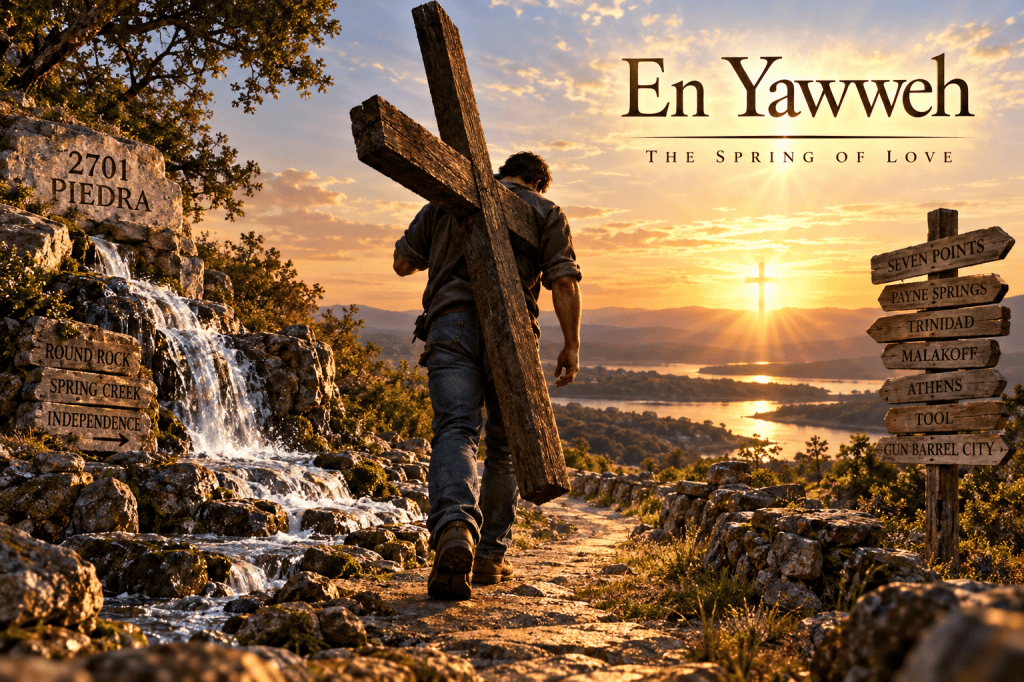
2701 Piedra
I was raised at St. Elizabeth Ann Seton Catholic Church in Plano, Texas.
Its address is:
2701 Piedra Drive.
The number 2701 is remarkable to me because the standard Hebrew gematria value of the first verse of Scripture—Genesis 1:1—is 2701.
“In the beginning God created the heavens and the earth.”
Creation.
Beginning.
Life proceeding from God.
Then comes Piedra.
In Spanish, piedra means stone or rock. It is grammatically feminine and descends ultimately from the same ancient rock vocabulary associated with Latin and Greek petra.
So in my contemplative reading of the road, my childhood parish sits at:
2701 — Creation.
Piedra — Rock.
And around it appear still more markers.
Round Rock.
Spring Creek.
Independence Parkway.
I see petra: foundation.
I see petros: the individual rock.
I see water.
And I see freedom.
Scripture already gave Christianity those images long before I encountered these particular roads.
Moses struck the rock and water came forth in the wilderness.
St. Paul gives the image its Christological center:
“The Rock was Christ.” — 1 Corinthians 10:4
At the Cross, Christ was pierced and blood and water flowed from His side.
The Rock gives water.
The water gives life.
And living water leads slaves through the wilderness toward freedom.
Rock.
Spring.
Creek.
Independence.
Road markers.
Seven Points
Then there is the landscape where I have lived more recently.
Seven Points.
Payne Springs.
Trinidad.
Malakoff.
Athens.
Tool.
Gun Barrel City.
I have come to contemplate these names as another series of road markers.
Seven Points immediately speaks to the spiritual journey I have written about: stages of purification, illumination and union.
The saints traditionally describe the spiritual Way through the purgative, illuminative and unitive ways.
I have contemplated that journey through seven points of growth, including the Beatitudes: purification, surrender, hunger for righteousness, mercy, purity and finally peace.
The seventh Beatitude says:
“Blessed are the peacemakers, for they shall be called children of God.” — Matthew 5:9
The road culminates not merely in knowing something about God, but in becoming His child and carrying His peace.
Then:
Payne Springs.
Through pain, a spring.
Suffering does not become good simply because it hurts. But God can bring living water out of the places where we believed nothing could live.
Then:
Trinidad.
Trinity.
And this is more than a name on a map for me. The Trinity River runs through this landscape, and I lived for more than a year in the Trinity River bottoms.
The water runs through the road.
Then:
Malakoff.
The Hebrew mal’akh means messenger and is the word commonly translated angel.
I contemplate it as messenger.
Then:
Athens.
A city whose ancient name naturally evokes philosophy, learning and wisdom.
Then:
Tool.
An instrument.
Something formed and equipped for work.
Then:
Gun Barrel City.
Warfare.
Not warfare against flesh and blood, but the spiritual battle described by St. Paul—the strange warfare in which the Christian is armed with truth, righteousness, faith, salvation and the Gospel of peace.
So when I contemplate these seven geographical markers together, I hear something like this:
Through Seven Points of pain springs living water; from the Trinity comes a messenger, formed in wisdom, made into an instrument, and sent into the battle carrying peace.
I do not offer that sentence as the dictionary definition of these towns.
It is the road as I have contemplated it.
The road by which I went.
The Spring
This is also why the word spring has become important to me.
A spring does not create the water it gives.
It receives from a source hidden beneath it.
Then the water comes forth.
That is how I understand Love.
I did not invent Love.
I encountered it.
I received it.
And when I received it, my first desire was that the people I loved would receive it too.
The movement is always outward and back:
From God.
Into creation.
Received by us.
Given to another.
Returned to God.
Exitus.
Reditus.
That is the Way.
A Good Name
There is another road marker I carried before I knew enough even to recognize it:
Matthew Wayne Gray.
My name.
I did not choose it.
It was given to me.
Scripture says:
“A good name is to be chosen rather than great riches, and favor is better than silver or gold.” — Proverbs 22:1
For much of my life people called me Matt.
But during thirteen months in Athens, while praying and preparing to go to prison, something changed.
I began asking people to call me by the name I had been given:
Matthew.
Not Matt.
Matthew.
Seven letters.
I had not chosen seven letters any more than I had chosen the ninth hour of my birth.
Later I began contemplating even the structure of that name.
MAT — T — HEW
I came to see Mat as an image of the earthly and fleshly man.
Hew suggested cutting, shaping, forming—the work of taking what is rough and fashioning it for a purpose.
And standing between them is:
T
The Cross.
One made from two through the Cross, establishing peace.
That contemplation brought me to Ephesians 2, where Christ makes the two one, creates one new humanity, establishes peace, and reconciles through the Cross.
Again, I do not claim that this is the etymological meaning of the English name Matthew.
It is how I came to contemplate the good name I had been given.
And the seven-letter name also met another pattern already appearing along the road: the seventh day, oath and covenant, seven stages of growth, Seven Points, and the seventh Beatitude—the peacemaker who is called a child of God.
The name had been given long before I understood any of those things.
That is precisely what made what I discovered next so striking to me.
En Yawweh
It was not a name I invented for a website.
It was not something I constructed because I needed a title for my story.
It was already there.
Hidden in the middle—the marrow—of the name I had carried from birth:
Matthew Wayne.
Look at the place where my first and middle names meet:
MAT T HEW WAYNE
Now begin with HEW WAYNE and read the letters in the direction Hebrew is read—from right to left:
E N Y A W W E H
EN YAWWEH.
Every letter is already present.
Nothing is added.
Nothing is removed.
I did not put it there.
I received the name before I could read it.
Before I knew Hebrew was written from right to left.
Before the wilderness.
Before jail.
Before I understood the Cross.
Before I contemplated seven, covenant, spring, rock, water, exitus or reditus.
The name came first.
Only afterward did I discover what was hidden within it.
And this is why the spelling matters.
I write Yawweh.
Not Yahweh.
Yawweh is not Yahweh.
I am not He.
I am part of we.
That difference is not an inconvenience to be corrected. For me, it is part of the meaning.
The Hebrew ayin/ein appears in names associated with an eye, spring or fountain.
And Yawweh, while not the divine Name, echoes Yahweh to my ear.
But the movement points away from me, not toward me.
He, not me.
The old “me” that wanted to possess, control and make everything its own died years ago. Christianity gave me something larger than an isolated self.
A Body.
A communion.
A we.
What I received was never meant to terminate in me.
Love comes from God, is received by us, passes through us toward one another, and returns to Him.
That is why En Yawweh became inseparable for me from the image of the spring.
A spring does not say:
I made the water.
A spring says nothing.
It simply lets the water it has received flow.
And so I hear in En Yawweh:
The Spring of Love.
Not because I am the Source.
Precisely because I am not.
He is the Source.
I receive.
We receive.
And what is received is given.
Perhaps that is why discovering those letters affected me so deeply.
I had spent years looking backward at road markers—dates, hours, crosses, towns, rivers, rocks, springs and numbers.
Eventually I discovered another marker hidden in the marrow of my own given name.
Not something I had placed there.
Something I had received.
A good name.
A gift.
MAT T HEW WAYNE
EN YAWWEH
And that is why this place is called:
enyawweh.com
The Way Home
Perhaps that is why all these road markers finally point toward the same place.
The Cross.
I was born at the ninth hour.
I wandered.
I entered the wilderness.
I cried for help.
Love answered.
I discovered that the Love I possessed had first been given to me.
I asked that it be given to my family.
I began returning.
I encountered the Rock.
Water came from the Rock.
I followed the spring.
And beneath the Cross, again at three in the afternoon, I returned my life to the One from whom it came.
But reditus does not mean returning alone.
Love received must become Love given.
Christ crucified remains foolishness to the world, but to those who are called He is the power of God and the wisdom of God.
So I will preach Christ crucified with my life, and when necessary, with my words.
I am still traveling.
I am still following the markers.
I am still learning the Way.
But I know where the water comes from.
I know where Love comes from.
And I know what I am supposed to do with what I have received:
Give it away.
Because Love can only return Love.
And every spring must flow toward somewhere.
“We love because He first loved us.”
That is the road by which I went.
That is the road home.
En Yawweh.
The Spring of Love.


Leave a comment